

Roughly 15% of the theory marks in SEAB 6092 are allocated to recall.
About 55% assess Handling Information and Solving Problems, so revision needs plenty of practice with unfamiliar data, deductions and multi-step working. A useful o level chemistry study guide should therefore train application alongside memory.
It should also reflect the current twelve-topic structure, including Experimental Chemistry and Maintaining Air Quality. The official syllabus places Atomic Structure inside Topic 2 and Electrochemistry inside Topic 7.
For Secondary 3 and Secondary 4 students in Singapore, the best weekly rhythm is simple: review a concept, answer a question that applies it, then check the exact wording, units and working expected.
Key takeaways
- Spend more practice time applying familiar concepts to unfamiliar information because about 55% of theory marks assess Handling Information and Solving Problems.
- Memorise qualitative analysis tables for Papers 1 and 2 because the printed reference material there is the Periodic Table.
- For Paper 3, practise precise observations and titration records because the Notes for Qualitative Analysis are supplied in the practical.
- When a question says ‘calculate’, show working for two or more steps and check units and significant figures.
How this o level chemistry study guide fits the three papers
The SEAB 6092 Chemistry syllabus sets three compulsory papers. An approved calculator may be used in all three.
| Paper | Format | Duration | Marks | Weighting |
| 1 | Multiple Choice, 40 compulsory items | 1 hour | 40 | 30% |
| 2 | Structured and Free Response | 1 hour 45 minutes | 80 | 50% |
| 3 | Practical | 1 hour 50 minutes | 40 | 20% |
Paper 2 has a 70-mark compulsory Section A and a 10-mark Section B where you answer one of two questions. Its last two Section A questions carry 20 marks between them, including one data-based question worth 8 to 12 marks. Papers 1 and 2 print the Periodic Table. Paper 3 prints the Notes for Qualitative Analysis.
Section I: Matter, Structures and Properties
1. Experimental Chemistry
What it covers. Experimental Design covers apparatus for time, temperature, mass and volume. Methods of Purification and Analysis covers solvents, filtration, crystallisation, evaporation, sublimation, distillation, fractional distillation, separating funnels, paper chromatography, Rf values and purity from melting or boiling point data.
Where students lose marks. Recording a burette result as 24.6 cm3 when the reading is 24.60 cm3 uses 0.1 cm3 precision. Burette readings should normally be recorded to the nearest 0.05 cm3.
One study action. This week, do one apparatus-and-method drill where you suggest the correct measuring device or separation method for eight short scenarios, then record every volume with appropriate precision.
2. The Particulate Nature of Matter
What it covers. Kinetic Particle Theory covers states, interconversion, diffusion and how molecular mass and temperature affect diffusion. Atomic Structure is sub-topic 2.2 and covers protons, neutrons, electrons, proton number, nucleon number, nuclide notation, isotopes and ions.
Where students lose marks. Giving Na+ eleven electrons copies the proton number and ignores the positive charge. Na+ has eleven protons and ten electrons.
One study action. Build a one-page table for eight atoms and ions, then deduce each number of protons, neutrons and electrons. Add two formal definitions because ‘define’ calls for a formal statement, and one diffusion explanation because ‘explain’ requires reasoning from theory.
3. Chemical Bonding and Structure
What it covers. This topic covers ionic, covalent and metallic bonding, plus structure and properties of materials. You need dot-and-cross diagrams, giant ionic lattices, metals as positive ions in a sea of electrons, alloys, simple molecular and giant covalent structures, including diamond and graphite.
Where students lose marks. Saying solid sodium chloride conducts electricity because its ions are charged treats charge as sufficient. In the solid lattice, the ions are fixed, while molten ionic compounds have mobile ions.
One study action. Make a comparison sheet for ionic, simple molecular, metallic and giant covalent structures. Link structure and bonding to melting point and electrical behaviour. ‘Compare’ requires both similarities and differences.
Section II: Chemical Reactions
4. Chemical Calculations
What it covers. Formulae and Equation Writing includes balanced equations, state symbols and ionic equations. The Mole Concept and Stoichiometry includes relative masses, the Avogadro constant, formulae, reacting masses, gas volumes at room temperature and pressure, limiting reactants, concentration, titration, percentage yield and percentage purity.
Where students lose marks. Using 24 dm3 per mole when the question states conditions outside room temperature and pressure applies the syllabus value beyond its stated condition.
One study action. Complete four mixed calculations this week. For every multi-step ‘calculate’ question, show each stage, attach the correct unit and check significant figures before marking.
5. Acid-Base Chemistry
What it covers. Acids and Bases covers ions produced, pH, strong and weak acids, neutralisation, acid reactions and oxide classification. Salts cover preparation routes and solubility rules. Ammonia covers the Haber Process.
Where students lose marks. Choosing titration to prepare an insoluble salt uses the wrong route. Insoluble salts are prepared by precipitation, while titration is used for a suitable soluble salt.
One study action. Make a two-column decision sheet that starts with the required salt and leads to the correct preparation method. Add the relevant solubility rule and one balanced equation for each route you practise.
6. Qualitative Analysis
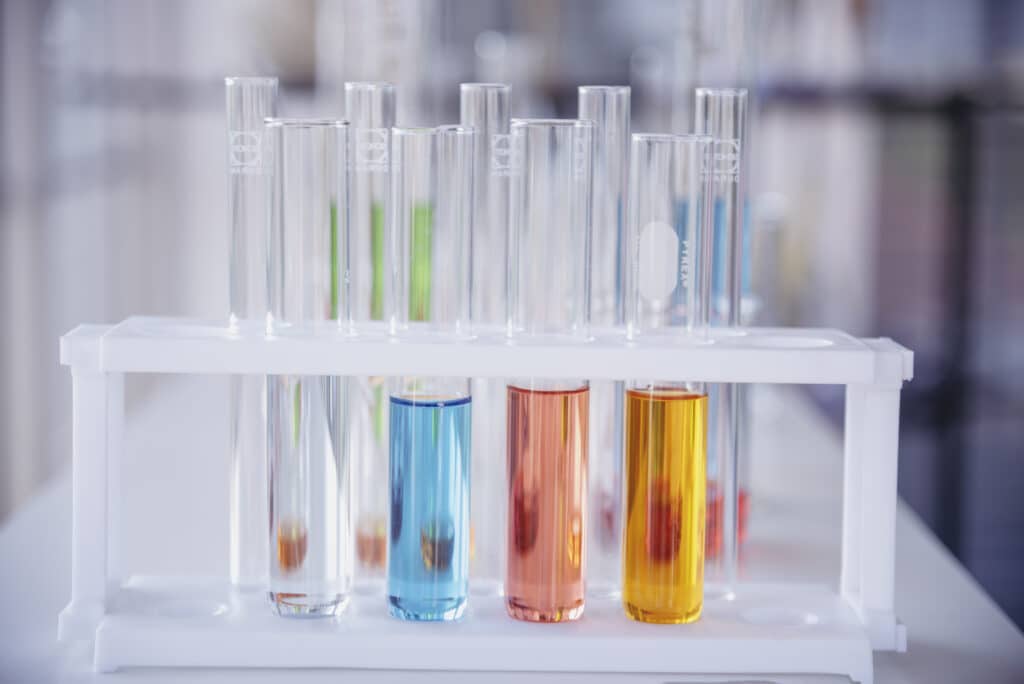
What it covers. You identify seven aqueous cations using aqueous sodium hydroxide and aqueous ammonia, five anions, and six gases. Chloride and iodide are on the anion list, while bromide is absent.
Where students lose marks. Zinc and aluminium both give a white precipitate soluble in excess aqueous sodium hydroxide. Treating those observations as identical misses the different behaviour with aqueous ammonia.
One study action. Practise four test sequences using about 1 to 2 cm3 of solution each time. Add reagents slowly with mixing, then describe colour changes, precipitates and any gas test at the stage where each appears.
7. Redox Chemistry
What it covers. Oxidation and Reduction uses oxygen, hydrogen, electron transfer and oxidation states. Electrochemistry includes molten and aqueous electrolysis, selective discharge, concentration effects, electrode ionic equations, copper purification, electroplating, simple cells and the hydrogen fuel cell.
Where students lose marks. Predicting an aqueous electrolysis product from the reactivity series alone can miss anion rules or concentration effects. A correct answer considers the species present at the relevant electrode.
One study action. Work through four electrolysis cases and write both products plus electrode ionic equations. For ‘predict’ or ‘deduce’, trace the logical connection from ions present to the final product.
8. Patterns in the Periodic Table
What it covers. Periodic Trends links position with proton number, electronic configuration and metallic character. Group Properties covers Groups 1, 17 and 18. Transition Elements covers catalysts, variable oxidation states and coloured compounds. Reactivity Series includes the named series, rusting and prevention.
Where students lose marks. Treating hydrogen as a metal because it appears in the reactivity series confuses its role. Hydrogen serves as a reference point in the series.
One study action. Draw the reactivity series from memory, then deduce outcomes for four displacement or metal-acid situations. After you finish, check the sequence against the printed Periodic Table and reactivity-series notes in your school materials.
9. Chemical Energetics
What it covers. This topic covers exothermic and endothermic reactions, signs of enthalpy change, energy profile diagrams, activation energy, bond breaking and bond making. You also explain overall enthalpy change from bonds broken and formed.
Where students lose marks. Giving an exothermic reaction a positive enthalpy change reverses the sign convention. Exothermic reactions have negative enthalpy changes, while endothermic reactions have positive ones.
One study action. Sketch four energy profiles and label reactants, products and activation energy. For two bond-energy questions, separate energy for bond breaking from energy released during bond making before deciding the overall sign.
10. Rate of Reactions
What it covers. Rate questions cover concentration, pressure, particle size and temperature through collision ideas. Catalysts, including enzymes, provide lower activation energy pathways. You may also suggest an investigation method and interpret rate data.
Where students lose marks. Writing ‘particles collide more often’ as the full explanation misses the energy condition. Higher temperature also increases the proportion of collisions with enough energy to react.
One study action. Choose one factor and plan a simple investigation. State what you change, measure and keep constant, then practise describing one graph and explaining its shape using collision theory.
Section III: Chemistry in a Sustainable World
11. Organic Chemistry
What it covers. Fuels and Crude Oil covers fractional distillation and biofuel. Hydrocarbons covers homologous series, C1 to C4 structures, isomerism, cracking and reactions. Alcohols, Carboxylic Acids and Esters covers functional groups and esterification. Polymers covers addition and condensation polymerisation, depolymerisation and recycling.
Where students lose marks. Writing CO2H as a full structural formula for a carboxylic acid leaves the displayed bonding incomplete. The syllabus says this form is unsatisfactory as a full structural formula.
One study action. Draw eight organic structures from names this week, then label each functional group and reaction type.
12. Maintaining Air Quality
What it covers. This topic covers air composition, pollutant sources and effects, catalytic converters, calcium carbonate for acid rain and flue gas desulfurisation, ozone depletion by CFCs, the carbon cycle and greenhouse gases.
Where students lose marks. Linking CFCs to acid rain mixes two environmental processes. CFCs are linked with ozone depletion, while nitrogen dioxide and sulfur dioxide contribute to acid rain.
One study action. Make one table linking each named pollutant with its source, effect and relevant control method. Cover one column and deduce the missing information.
Which topics repay the most revision time?
These five topics carry the heaviest mark load in practice because they anchor the data-based question, the practical paper and multiple structured questions. SEAB publishes paper and assessment-objective weightings rather than topic-level marks, so this ranking reflects where marks concentrate across Papers 2 and 3.
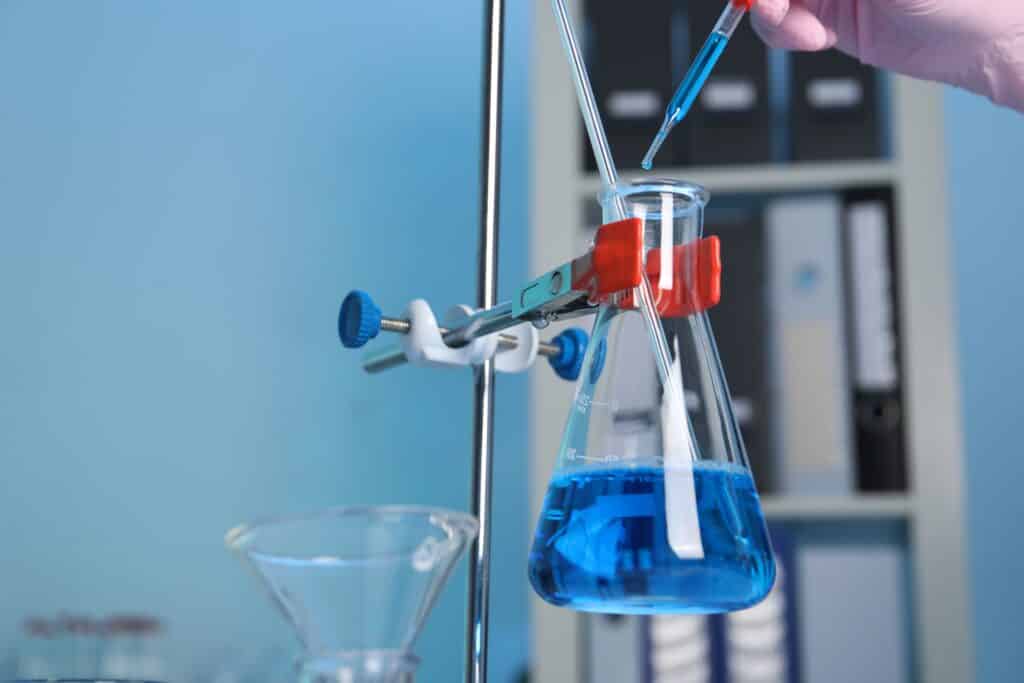
- Topic 4 Chemical Calculations links Paper 2 structured work with Paper 3 titration processing. Secondary mathematics problem solving also reinforces careful working.
- Topic 6 Qualitative Analysis spans theory and practical skills, with its reference table supplied in Paper 3.
- Topic 7 Redox Chemistry includes electrolysis, product prediction and electrode equations.
- Topic 5 Acid-Base Chemistry supplies salt-preparation routes and the solubility rules that select them.
- Topic 11 Organic Chemistry has four sub-topics, the largest count. Focused O Level Pure Chemistry tuition can connect its reactions.
What the syllabus says you do not need to learn
The official SEAB 6092 Chemistry syllabus sets useful revision boundaries.
- You do not need gas laws, gas-volume calculations at different temperatures and pressures, or pH calculations from hydrogen ion concentration.
- Le Chatelier’s Principle and Brownian motion are not required.
- The s, p, d and f classification is not required, and candidates are not required to draw ionic lattice diagrams.
- You do not need diamond or graphite drawings, complex-ion formulae in qualitative analysis, or technical details of copper purification and fuel-cell construction or operation.
- In Paper 3, candidates are not required to dry gases or carry out tests involving sulfur dioxide gas.
November 2026 is the final GCE O-Level examination for school candidates. From 2027, the O-Level and N-Level examinations combine into the Singapore-Cambridge Secondary Education Certificate (SEC), with Chemistry offered at G3 under code K324.
SEAB states that overall examination standards remain unchanged. The 2027 G3 syllabuses list K324 Chemistry.
Turn this guide into weekly revision
Use this o level chemistry study guide as a working checklist. Pair recall with application, then correct the wording, units and working that cost you marks. Give extra time to calculations, qualitative analysis, redox, acid-base chemistry and organic chemistry when your own answers show gaps.
Keep Paper 3 practice precise, especially observations and titration records. Tonight, choose one weak topic and complete four questions before checking every error against the syllabus.
If you would like guided practice, The Heuristic Way offers O Level Pure Chemistry tuition in small classes at Bukit Batok.
Frequently Asked Questions
Do I need to memorise qualitative analysis for the theory papers?
Yes. Papers 1 and 2 print the Periodic Table, while Paper 3 prints the Notes for Qualitative Analysis. Memorise the table for theory and practise using the supplied notes in practical work.
Is electrolysis a separate O-Level Chemistry topic?
Electrolysis sits inside Topic 7 Redox Chemistry as sub-topic 7.2 Electrochemistry. Revise it with oxidation, reduction and electrode equations.
Is this guide for Combined Science Chemistry too?
This guide follows Pure Chemistry 6092 and its twelve topics. Combined Science students should use Combined Science Chemistry support for their course.
What should I revise first if time is short?
Start with your weakest connected topic. Chemical Calculations, Qualitative Analysis, Redox Chemistry, Acid-Base Chemistry and Organic Chemistry connect across topics, practical skills or several sub-topics.